
Applied case · Europe · Semiconductor autonomy · 2035
Europe and the Semiconductor Autonomy Question
How can Europe reduce its most consequential semiconductor dependencies without trying to reproduce the entire global value chain?
The strategic problem
Autonomy is not the same as producing everything.
Europe has strengths in semiconductor equipment, industrial applications, research and specialised technologies. Yet some of the capabilities on which advanced electronic systems depend remain concentrated outside Europe. Investments in domestic capacity can reduce exposure, but manufacturing more chips does not automatically remove the vulnerabilities that matter most.
The question is how to distinguish dependencies that merely require management from those capable of constraining Europe's strategic freedom. It is also a question of timing: facilities, skills, supplier ecosystems and customer qualification cannot be created instantly, while technology and geopolitical conditions continue to change.
Focal actor
The European Union as an institutional, economic and industrial system.
Strategic counterpart
China, within a wider semiconductor system that also includes Taiwan, the United States and South Korea.
Objective
Greater European semiconductor strategic autonomy by 2035 while preserving industrial competitiveness.
Strategic choice
Where to concentrate domestic capability-building, where to experiment and learn, and where to protect access through external relationships.
What the analysis adds
From industrial ambition to strategic discrimination.
The reference 6C comparison does not select a factory, a subsidy or a spending programme. It identifies a leading pattern of strategic engines: using time deliberately, building gains cumulatively, testing before expanding, renewing capabilities before disruption and establishing preventive barriers against critical dependence.
Target decisive vulnerabilities
Judge new capabilities by the constraints they actually remove, not simply by headline investment or production-volume targets.
Learn before scaling
Use bounded programmes, qualification and industrial learning to separate credible capabilities from nominal capacity and speculative commitments.
Preserve room to adjust
Recognise long industrial cycles without locking the Union prematurely into choices that changing technology or supply patterns could weaken.
Decision Robustness
How much does the leading strategic direction depend on its assumptions?
The reference case reports 111 one-variable-at-a-time sensitivity tests. Each changes one calibrated assessment while holding the others fixed, allowing the analysis to distinguish shifts in emphasis from changes in the leading strategic families.
Tests retained the reference leading family structure, although ranking or engines within those families could change.
Tests changed the leading family composition while retaining at least one family from the reference configuration.
Tests produced a leading family configuration with no family in common with the reference.
Four in-range directions deserve particular attention
Complete family switches occurred within plausible assessment ranges when the EU's relational capacity or Context Adherence was reduced, or when the objective's requirements for those conditions increased.
What moves into view?
Depending on the change, the leading logic shifts toward Relational context shaping, sometimes joined by Dependency rebalancing and selective withdrawal. Different sensitivity directions must not be treated as one identical alternative.
These test counts describe simulated outcomes, not probabilities of future events. Two additional complete-switch directions were observed outside the recorded plausible ranges; details are available in the analytical material.
The 6C method
From context to simulation to interpretation.
The case combines human–AI contextual analysis, a distinct computational comparison through the 6C server, and AI-assisted interpretation of the resulting strategic configurations. The central simulation phase compares 60 strategic motors and subjects the leading configuration to repeated robustness tests.
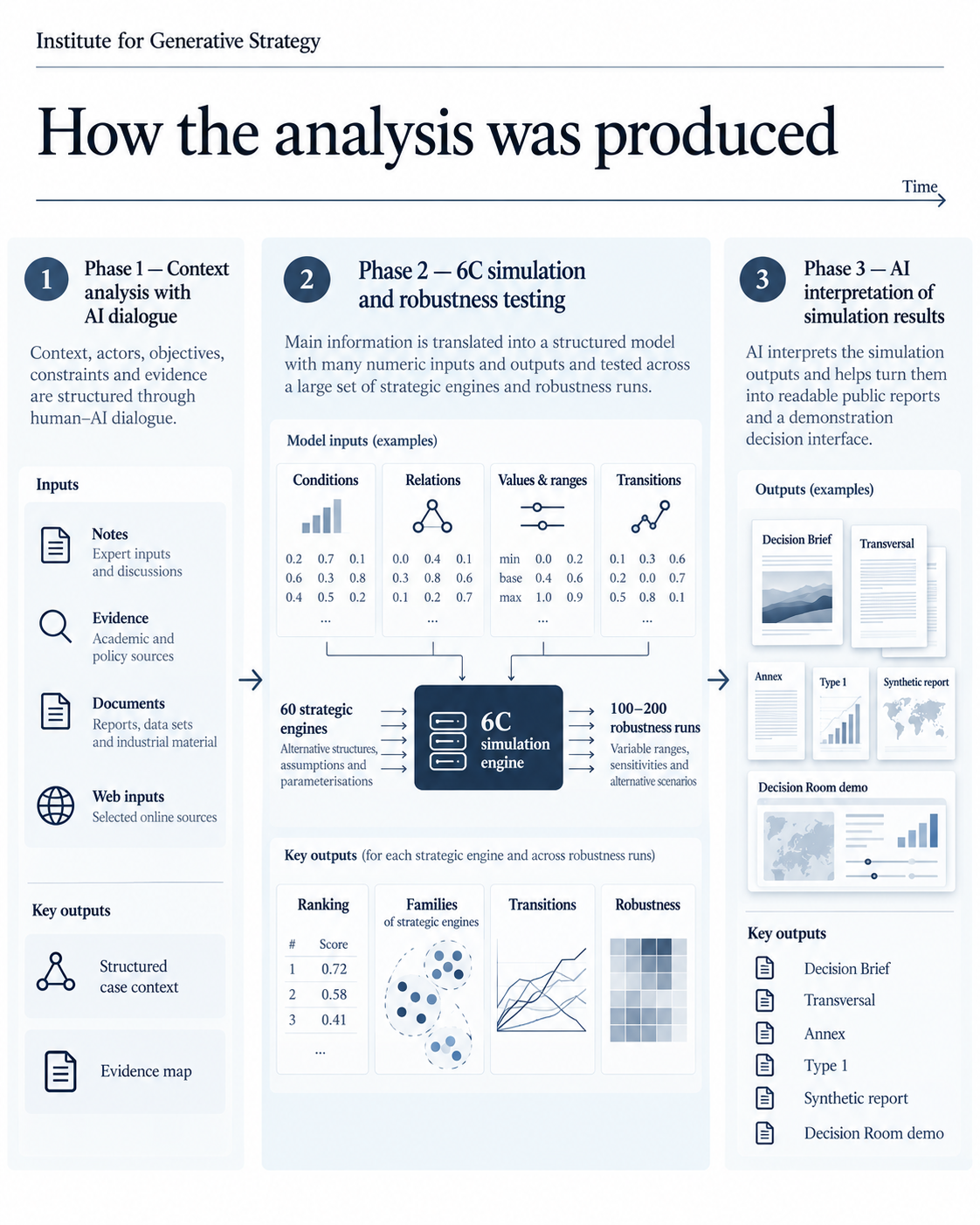
Case publications
Read the case at the level of detail you need.
Each document serves a different reading purpose. The report titles in the first column link to the downloadable PDFs. A view-only Decision Room demonstration is planned, but is not yet published.
| Report name | What it contains and why to read it | Pages |
|---|---|---|
| ↓Decision Brief | An executive reading of the prevailing direction, decision-critical sensitivities, alternatives and choices that still require human judgment. The best starting point. | 4 |
| ↓Transversal | An accessible narrative bringing together the strategic question, cross-cutting findings, leading choice, robustness and reassessment triggers. Read it for the complete argument in concise form. | 12 |
| ↓Analytical Annex | The traceability layer: recorded assessments, assumptions, evidence connections and sensitivity results underpinning the conclusions. For readers who want to examine the analytical basis. | 57 |
| ↓Type 1 — Extended Analysis | The developed context analysis and an exploration of the highest-ranked strategic motors: why they fit, their strengths and opportunities, as well as their tensions and criticalities. | 52 |
| ↓Synthetic Report | A structured middle-length reading of the leading strategic directions and their implications, for readers who want more detail than the Decision Brief without starting from the full dossier. | 16 |
| ↗Decision Room — Demo (forthcoming) | A planned non-interactive view of the strategic field, leading families, robustness and reassessment in a decision interface. It will not run simulations. | Web |
Strategic choice before planning